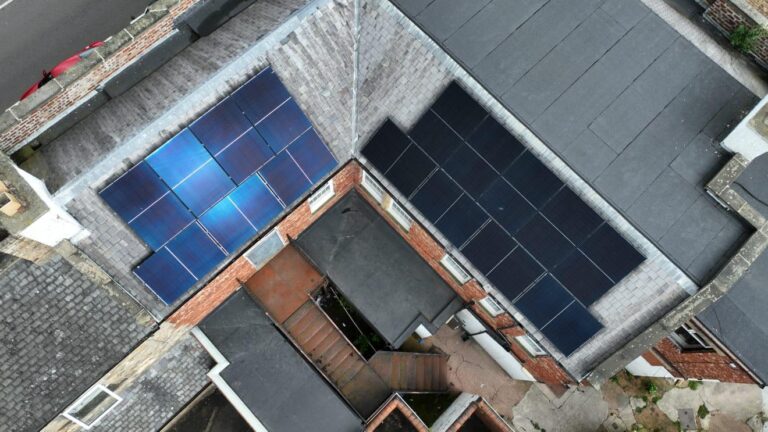
As businesses prepare for the EV transition, installing solar panels in commercial buildings can help manage energy demand and cut costs.
Energy challenges faced by commercial buildings
No longer just shells of offices and shared spaces, commercial buildings now face rising energy costs, increasing tenant expectations, and the looming 2030 EPC B regulations. This has resulted in a series of challenges:
- High daytime electricity consumption, especially in office hours
- Rising daytime tariffs
- Growing demand for onsite EV charging
- Sustainability reporting obligations
- Building value strongly linked to EPC and ESG metrics
- Competition for tenants based on amenities and green credentials
As a result, commercial buildings are now expected to behave more like small energy ecosystems: they must generate power, manage demand, support electric vehicles, and prove their environmental credentials.
Solar panels: a natural fit for commercial buildings
In this new landscape, solar power technologies are becoming one of the main pillars of modern building strategy, reshaping a commercial building’s energy profile by lowering costs, and improving efficiency,
Furthermore, solar panels can turn the rooftop and car park into strategic assets: commercial buildings consume most of their electricity during daylight hours, when solar panels do their most effective work.
This alignment makes solar one of the most financially beneficial upgrades available today.
Key financial & operational benefits of solar panels
This alignment makes solar one of the most financially beneficial upgrades available today:
- Immediate reduction in electricity bills
- Predictable and stable long term energy costs
- Strong contribution to EPC B improvement
- Tangible sustainability and Scope 2 reductions
- Opportunity to store solar power for late afternoon peaks (when paired with a battery)
- Increased asset value and tenant appeal
Most commercial roofs are flat or lightly pitched, making installation straightforward. Even smaller systems can offset a significant fraction of daytime power demand.
Adopting solar panels and other solar power technologies also signals to tenants that the building is modernising and adapting, an increasingly important differentiator in competitive markets.
Solar panels + EV charging: a single integrated system
The most effective commercial energy strategies pair solar generation with EV charging, and, where beneficial, a small battery for load smoothing.
When these assets work together, the commercial building behaves like its own ecosystem
Benefits of integration:
- Charge vehicles using your own solar energy, reducing imported electricity
- Fewer grid constraints because solar handles part of the load
- Lower operational energy costs through self-consumption
- Improved EPC rating
- Highly attractive to tenants and staff
- Supports corporate fleet electrification
For office parks and multi-tenant buildings, this is becoming a key amenity: a practical sustainability benefit that tenants can see and use daily.
Solar power and battery storage
Not every commercial building needs a battery, but many benefit from one:
- Sites with peak demand charges
- Multi-tenant buildings with unpredictable load patterns
- EV hubs with clustered chargers
- Buildings with solar looking to optimise self-consumption
- Locations with grid constraints
A battery smooths the load profile, reduces penalty tariffs and ensures EV charging doesn’t create sudden spikes.
The financial case for solar panels: strong and getting stronger
Commercial buildings using solar alone are typically seeing:
- 30 – 60% reduction in daytime grid import
- 5 – 7-year payback periods
- Higher property valuation from improved EPC rating
- CAPEX offset through grants or tax incentives
- Higher occupancy rates for green certified buildings
Adding EV charging improves tenant value and provides a secondary income stream through usage billing.
Example:
office park solar + EV integration installed:
- 350 kWp solar system
- 20 EV chargers with smart load balancing
- Optional 100 kWh battery for peak control
The results:
- £55k annual energy savings
- 22% higher solar self-consumption
- EPC lifted from C to B
- EV charging revenue recovering 40% of infrastructure cost
Case examples
- Multi-Tenant Office Building, Southeast
Challenge: Tenants requesting EV charging; grid unable to support additional load. Solution: Smart chargers + rooftop solar panels.
Outcome: No grid upgrade required; building now covers 42% of EV charging demand via solar.
- Commercial HQ, West Midlands
Challenge: Rising daytime energy bills and sustainability targets.
Solution: 250 kWp solar, monitoring & controls.
Outcome: £38k saved annually; EPC improved; building marketed as a ‘green tenancy hub.’
Strengthen your commercial building’s energy strategy with solar panels
Commercial buildings aren’t just places of work; they’re becoming flexible energy assets. Solar panels create a more efficient, sustainable, and future-ready site that benefits both owners and tenants.
The Energy Group helps commercial property operators design and integrate systems that lower costs, improve compliance, and support the shift to electric mobility.
Talk to us about:
- Solar for commercial buildings
- EV charging strategy and installation
- Smart charging systems
- Battery storage for load balancing
- EPC B compliance planning
Book a consultation today and start transforming your building’s energy future.